
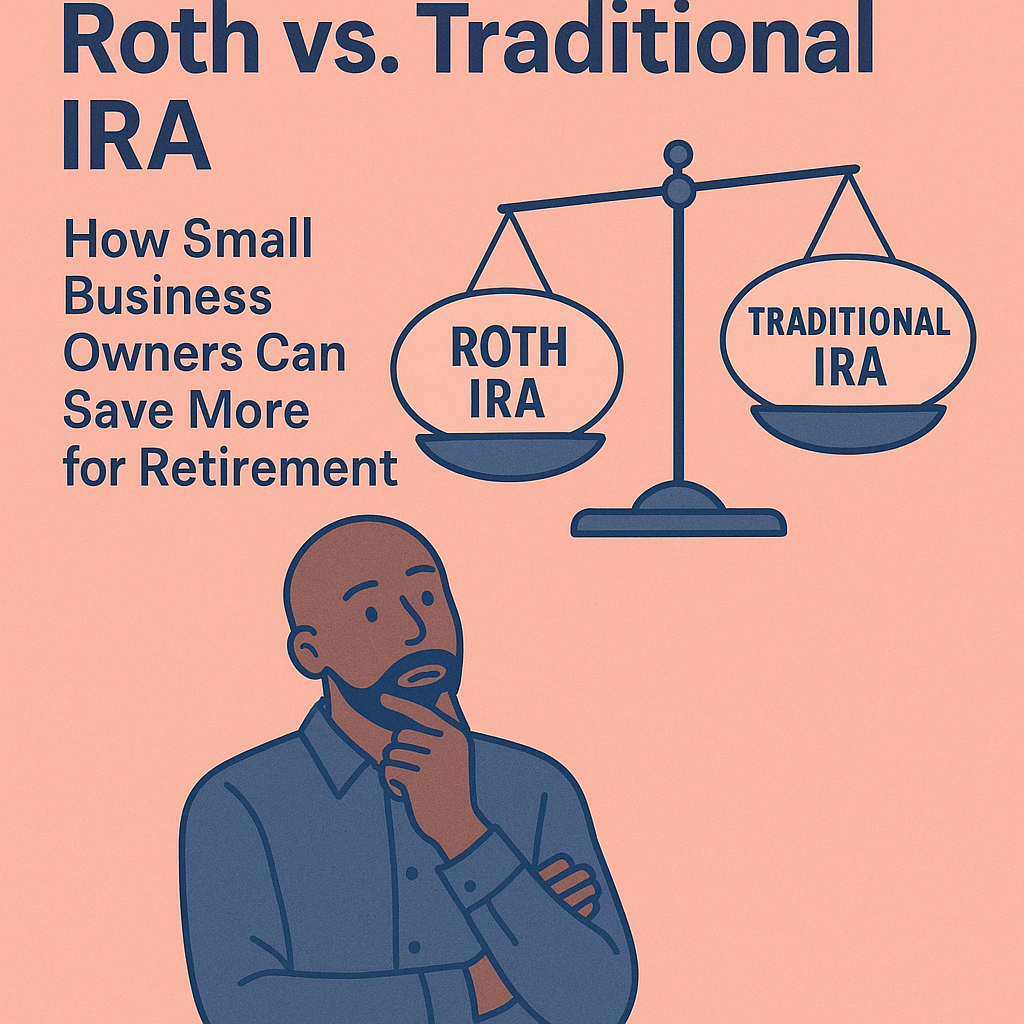
Traditional vs. Roth IRAs for Small Business Owners: Your Foundation for Retirement Success
As a small business owner, you face unique retirement planning challenges that traditional employees never encounter. While corporate employees enjoy employer-sponsored 401(k) plans with matching contributions and professional management, you’re on your own to create a retirement strategy that works with fluctuating income and unpredictable cash flow.
The good news is that you have powerful retirement savings tools at your disposal — you just need to understand how to use them strategically. Traditional and Roth IRAs represent the foundation of retirement planning for many small business owners, offering tax advantages and flexibility that can adapt to your changing business circumstances.
Whether you’re just starting to generate profits or looking to optimize an existing retirement strategy, understanding the differences between traditional and Roth IRAs can help you make informed decisions that maximize your long-term wealth while minimizing current tax burdens.
Why can’t I just rely on my business profits for retirement like employees rely on pensions?
Many new business owners assume their business will provide all the retirement income they’ll ever need. This thinking can be dangerous for several reasons that make proactive retirement planning absolutely essential.
Unlike traditional employees who receive steady paychecks and employer-sponsored benefits, your income as a business owner fluctuates based on market conditions, seasonal demands, client retention, and countless other variables. What looks like substantial income in a good year can disappear quickly during economic downturns or industry changes.
Business value also doesn’t always translate to liquid retirement income. You might own a successful business worth hundreds of thousands of dollars on paper, but converting that value to retirement income requires finding buyers, navigating complex sales processes, and potentially accepting less than expected value.
Consider this reality: studies show that only about 20% of businesses ever sell for their anticipated value, and many business owners find themselves unable to retire comfortably solely on business sale proceeds. Meanwhile, employees with consistent 401(k) contributions often accumulate substantial retirement wealth through steady, tax-advantaged savings over decades.
This is why IRA planning becomes so crucial for business owners — it provides guaranteed, portable retirement savings that aren’t dependent on business performance or sale value.
What makes traditional IRAs a good starting point for new business owners?
Traditional IRAs offer an excellent entry point for business owners who are just beginning to generate consistent profits. These accounts provide immediate tax relief when you might need it most, along with the flexibility to start small and increase contributions as your business grows.
For 2025, IRA contribution limits are $7,500 for those under age 50, with an additional $1,000 catch-up contribution for those 50 and older totaling $8,500.
The immediate tax deduction can be particularly valuable for new business owners managing variable income. Every dollar contributed to a traditional IRA reduces your current taxable income dollar-for-dollar. If you’re in the 22% tax bracket and contribute the full $7,500, you’ll save approximately $1,650 in federal taxes alone, plus potential state tax savings.
Here’s a practical example: Sarah launched her consulting business and earned $60,000 in her first profitable year. By contributing $7,500 to a traditional IRA, she reduced her taxable income to $52,500, saving significant taxes while building retirement wealth. The tax savings helped improve her business cash flow during those crucial early years.
Traditional IRAs also offer investment flexibility, allowing you to choose from thousands of investment options based on your risk tolerance and timeline. Your contributions grow tax-deferred, meaning you won’t pay taxes on gains, dividends, or interest until withdrawal, allowing for more efficient compound growth.
How do contribution limits & catch-up contributions work?
Understanding IRA contribution limits helps you maximize tax benefits while staying compliant with IRS regulations. For 2025, IRA contribution limits are $7,500 for those under age 50, with an additional $1,000 catch-up contribution for those 50 and older totaling $8,500.
This limit applies collectively to all IRAs (traditional & Roth).
2025 IRA Contribution Guidelines:
- Under age 50: Maximum annual contribution of $7,500 across all IRA accounts
- Age 50 and older: Additional $1,000 catch-up contribution for total of $8,500 annually
- Income limits: Traditional IRA deductions may phase out at higher income levels if you have employer retirement plans
- Deadline flexibility: IRA contributions for a tax year can be made up until the tax filing deadline, typically April 15 of the following year.
- Business structure impact: Contribution limits are the same regardless of whether you’re a sole proprietor, LLC member, or corporation owner
The catch-up contribution provision recognizes that older business owners may need to accelerate retirement savings. If you spent your 30s and 40s reinvesting everything back into your business, the additional $1,000 contribution at age 50+ helps make up for lost time.
Consider this scenario: Mark, a 52-year-old business owner, realizes he’s behind on retirement savings after focusing entirely on business growth. The catch-up contribution allows him to save an extra $1,000 annually in his IRA, plus he can often contribute more through business retirement plans like SEP-IRAs or Solo 401(k)s as his business grows.
What are the tax advantages of traditional IRA contributions?
Traditional IRAs provide immediate tax relief that can significantly impact your current financial situation while building long-term wealth. Understanding these tax advantages helps you make informed decisions about how much to contribute and when.
Every dollar contributed to a traditional IRA reduces your current taxable income, providing immediate tax savings. This deduction comes “above the line,” meaning it reduces your adjusted gross income regardless of whether you itemize deductions or take the standard deduction.
Traditional IRA contributions are tax-deductible depending on your income and whether you participate in an employer retirement plan, but even non-deductible contributions still enjoy tax-deferred growth.
The tax-deferred growth advantage compounds over time. Inside your traditional IRA, investments grow without annual tax consequences. You won’t pay taxes on capital gains when you rebalance portfolios, receive dividends, or earn interest. This tax-deferred treatment allows your money to compound more efficiently than taxable investments.
Here’s a powerful example of tax-deferred growth: suppose you contribute $7,500 annually to a traditional IRA with a 7% average return. After 25 years, you’d have approximately $473,000. About $286,500 of that total comes from investment growth that wasn’t reduced by annual taxation.
The timing of tax payments also works in your favor. You get immediate deductions during your working years when you might be in higher tax brackets, then pay taxes on withdrawals in retirement when your income (and likely tax bracket) may be lower. However, remember that traditional IRA investments grow tax-deferred with withdrawals taxed as ordinary income; RMDs start at age 73. This makes traditional IRAs most beneficial for business owners who expect to be in lower tax brackets during retirement.
When should I consider a Roth IRA instead?
Roth IRAs operate on the opposite tax principle from traditional IRAs — you pay taxes now but enjoy tax-free withdrawals later. This approach can be incredibly powerful for business owners in specific situations, particularly those just starting out or expecting higher future income. Roth IRA contributions are made after tax, but qualified withdrawals are tax-free with no required minimum distributions.
Roth IRAs Work Best When:
- Low current tax liability: You have minimal taxes due to business startup costs, depreciation, or other deductions
- Expected income growth: You anticipate being in higher tax brackets as your business grows and matures
- Young business owner: You have decades for tax-free growth to compound without annual tax drag
- Tax diversification: You want a mix of taxable, tax-deferred, and tax-free accounts for retirement flexibility
- Estate planning: Roth IRAs don’t require distributions during your lifetime and pass tax-free to beneficiaries
Consider this example: Jennifer started her graphic design business at age 28 with minimal initial profits. Due to business startup expenses and equipment depreciation, she owed very little in taxes. Instead of traditional IRA contributions that would provide minimal current tax benefits, she chose Roth contributions. Over 35 years, her annual $7,500 Roth contributions grew to over $1.2 million, all available tax-free in retirement. Meanwhile, her business income grew substantially, putting her in much higher tax brackets later in her career — making those early Roth contributions incredibly valuable.
How does fluctuating business income affect my IRA strategy?
Variable income represents one of the biggest challenges business owners face in retirement planning, but it also creates unique opportunities for strategic IRA contributions. Understanding how to adapt your strategy to income fluctuations can maximize long-term benefits. Business owners may contribute to traditional IRAs in higher income years for immediate tax savings and Roth IRAs in lower income years to maximize future tax-free growth.
Some business owners employ a hybrid strategy, contributing to traditional IRAs during profitable years and Roth IRAs during slower periods. This approach provides tax diversification and flexibility to optimize based on annual circumstances.
The deadline flexibility for IRA contributions becomes particularly valuable for business owners. You can wait until you prepare your tax return to decide which type of contribution makes most sense, then fund your IRA accordingly before the filing deadline.
Here’s how this might work: suppose your business had an unexpectedly profitable year due to a large client contract. You can make a traditional IRA contribution to help offset some of that income. Conversely, if business was slow and you’re in a lower tax bracket, a Roth contribution locks in tax-free future growth at favorable current tax rates.
Remember that you can also adjust contribution amounts based on cash flow. You’re not required to contribute the maximum — even smaller, consistent contributions can build substantial wealth over time through compound growth.
What investment options do I have within my IRA accounts?
One of the biggest advantages of IRAs over employer-sponsored plans is the incredible investment flexibility they provide. IRAs offer broad investment flexibility, including stocks, bonds, ETFs, mutual funds, REITs, and alternative assets, unlike many employer-sponsored plans with limited fund choices.
Most IRA providers offer extensive mutual fund selections, including low-cost index funds, actively managed funds, target-date funds, and specialty sector funds. You can also invest in individual stocks, bonds, exchange-traded funds (ETFs), real estate investment trusts (REITs), and even alternative investments like precious metals in some accounts.
This flexibility becomes particularly valuable for business owners who understand specific industries or want to diversify beyond traditional investments. For example, a business owner in the technology sector might choose to avoid tech-heavy investments in their IRA to reduce overall portfolio concentration risk.
Target-date funds provide an excellent “set it and forget it” option for busy business owners. These funds automatically adjust their asset allocation as you approach retirement, becoming more conservative over time. They’re professionally managed and require minimal ongoing attention — perfect for entrepreneurs focused on running their businesses.
Low-cost index funds represent another popular choice, providing broad market exposure with minimal fees. Since high fees can significantly erode long-term returns, many financial experts recommend index funds as core holdings for retirement accounts.
Can I contribute to an IRA even if I have other retirement plans?
Business owners often wonder whether they can contribute to IRAs if they also have business retirement plans like SEP-IRAs, Solo 401(k)s, or employer plans from other jobs. The answer depends on your specific situation and income levels. For 2025, the Roth IRA contribution eligibility phases out between $150,000 and $165,000 of modified adjusted gross income (MAGI) for single filers, and $236,000 to $246,000 for married filing jointly. Contributions are not allowed above those thresholds.
Traditional IRA contributions are always allowed regardless of income, but the tax deductibility may be limited if you participate in employer retirement plans and exceed certain income thresholds. However, even non-deductible traditional IRA contributions can make sense for the tax-deferred growth benefits.
Participation in other retirement plans affects Roth IRA income eligibility and traditional IRA deduction limits, but you can generally contribute to IRAs regardless.
Many business owners use IRAs as supplemental retirement savings alongside business retirement plans. For example, you might maximize contributions to a SEP-IRA through your business, then also contribute to a Roth IRA for tax diversification.
The key is understanding how different retirement accounts work together in your overall strategy. Business retirement plans often allow much higher contribution limits, while IRAs provide investment flexibility and different tax treatments.
How do I actually set up & fund my IRA?
Setting up an IRA is surprisingly straightforward, and you have flexibility in both timing and funding methods. IRA accounts can be easily opened online at most brokerages, funded via direct contributions, rollovers, or transfers, with flexibility on timing.
When choosing an IRA provider, consider factors like investment options, fees, customer service, and online platform usability. Many providers offer commission-free stock and ETF trades, while others specialize in mutual funds or provide access to alternative investments.
You can fund your IRA through several methods: direct contributions from your bank account, rollovers from other retirement accounts, or transfers from existing IRAs. The funding doesn’t need to happen all at once — many people make monthly contributions throughout the year to spread out the cash flow impact.
IRA contributions for a tax year can be made up until the tax filing deadline, typically April 15 of the following year.
According to the IRS guidelines for IRA contributions, you have until the tax filing deadline (typically April 15th) to make contributions for the previous tax year. This deadline flexibility allows business owners to assess their annual tax situation before deciding on contribution amounts and types.
Remember to designate whether contributions are for the current tax year or previous tax year when making deposits near the deadline. Proper designation ensures contributions are applied to the correct tax year for deduction purposes.
How do IRAs fit into my broader business and retirement strategy?
IRAs represent just one component of comprehensive retirement planning for business owners. As your business grows, you’ll likely want to explore additional retirement savings vehicles like SEP-IRAs, Solo 401(k)s, or defined benefit plans that allow much higher contribution limits.
The beauty of starting with IRAs is that they provide a foundation you can build upon. Many business owners begin with traditional or Roth IRAs when profits are modest, then add business retirement plans as cash flow improves. The accounts work together to provide tax diversification and maximum retirement savings opportunities.
Consider how your IRA strategy coordinates with other financial goals. Are you also building emergency funds, paying down business debt, or saving for equipment purchases? Balancing competing financial priorities requires careful cash flow management and strategic thinking.
Estate planning considerations also matter. Roth IRAs pass to beneficiaries tax-free and don’t require distributions during your lifetime, making them valuable estate planning tools. Traditional IRAs require minimum distributions starting at age 73, which affects retirement cash flow planning.
Business succession planning intersects with retirement planning as well. If you’re planning to sell your business to fund retirement, IRAs provide additional security and diversification beyond relying solely on business sale proceeds.
How can I optimize my IRA strategy as my business evolves?
Your IRA strategy should evolve along with your business success and changing tax circumstances. What makes sense when you’re starting out may not be optimal as your business grows and your tax situation becomes more complex.
Regular strategy reviews help ensure your retirement planning stays aligned with your current situation. As your business income increases, you might shift from Roth to traditional contributions to take advantage of higher current tax brackets. Alternatively, you might add business retirement plans while maintaining IRA contributions for diversification.
Review and adjust your IRA strategy regularly in response to income changes and tax law updates, balancing Roth and traditional contributions, and integrating business retirement plans.
Tax law changes also affect optimal strategies. Contribution limits adjust annually for inflation, tax brackets change, and new legislation can create opportunities or challenges for retirement planning. Staying informed about these changes helps you adapt your approach accordingly.
Professional guidance becomes increasingly valuable as your business and retirement planning needs become more complex. The interaction between business structure, tax planning, retirement contributions, and investment management requires coordination to optimize your overall financial position.
Our comprehensive business packages include strategic tax planning, complete bookkeeping and accounting support, and ongoing business consulting designed specifically for growing businesses. We help business owners coordinate their retirement planning with their overall business and tax strategy for maximum benefits and compliance.
Ready to build a solid foundation for your retirement while optimizing your current tax situation? Ready to optimize your taxes and retirement? Book a free consultation with J.R. Martin & Associates today. Go to jrmartincpa.com to learn more about our business packages and discover how our experienced team can help you develop a retirement strategy that grows with your business success. Let us handle the complexity while you focus on building your business and securing your financial future. Learn more and get more tools here Retire Smart: Simple IRA for Business Owners